The IT Resume 101 – Part 1

The IT Resume

You got your IT cetification or passed your University courses and ready to get into the job market. You’ve googled resumes. There’s so many types out there. Some are visually awesome. Some are boring. You like a few, but now what? Do I copy it and just start adding in items? Does it apply to me? You might even have built one and submitted it a few times and got no one calling you back – Now What?

Why you can’t get an IT Job

Biggest Problem about resumes?

The biggest problem as a hiring manager for a large IT organization, is I see hundreds of resumes everytime I put a job posting out. Some of the resumes have tons of skills, but not very relevant to the role I’m hiring for. It also gives me a good indicator of what happened.

I’ll use my favorite fictional IT character, Joe the IT guy in my example. Joe the IT Guy is looking for work. He goes on his favorite job search site and applies to 10-20 jobs. Fills out each application, submits his resume. Then goes off to browse his social media site waiting for a response. Does this sound like you?

The big problem of those coming off of other fields is their past experience. They got advice from a career counselor, or a brother or sister, or a friend about how to build a resume. They might just randomly google a resume and started marching forward.

IT Resumes – not 1 Size Fits All

That advice they’ve gotten – usually comes from people who applied for jobs that are very transient. Meaning, it’s not based on a specific skill set. Hiring managers might just be interested in your basic skills (organization, analytical, etc.) and can hire you into their organization. Joe the IT Guy is under a lot more constraints.

If I’m hiring an arhictect, and see resumes with 10 or 20 coding languages, and nothing else, it gets thrown out. If I hire for a cloud engineer, and all they talk about is IT program management, that also gets thrown out. So what do you do?

The steps to a Great IT Resume

Let’s start off with making sure you have a very good resume. This post is about the 101 – the basic introduction to building a resume. I will follow up with more steps and possibly a video to describe all of this for the visual learner.
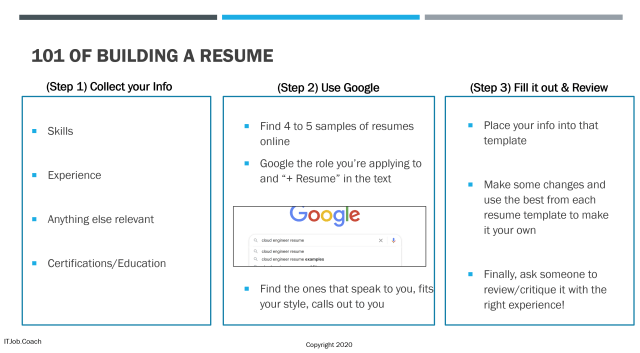
3 steps of building a resume. Collect your info, Find examples, and fill it out.

Let’s get started on the 3 basic steps of getting a good resume.

Step 1 – Collecting your info

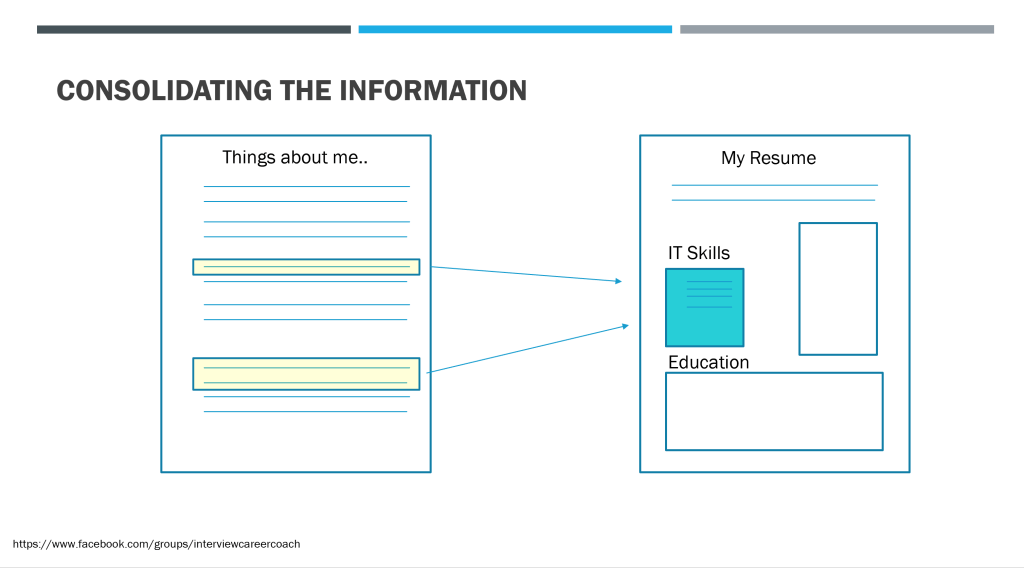
Collect all your information including your skills, any experience that shows you demonstrating your skills, your certifications, awards, education and put it on a single piece of paper. We’ll call this “Things about Me“.

In this step, more is better. Anything goes. Add Charity work, add information about how you helped your brother build a model plane in the garage and now he flies realy planes, etc.

Don’t worry about too much at this stage. All examples help. We won’t use all of it, but if we ever do need it, we will have it ready.

If you don’t have a lot of job experience, I will have a future blog on what to do.

Step 2 – Use Google

Now, start collecting sample resumes online. Use google and be specific about the job you’re looking for. Make sure you have a few that really call out to you. You’re feeling comfortable that it can create a good structure to represent what you’ve collected in step 1.

As a good google trick, and most of you know this, when you search for “Cloud Engineer” as an example, you can use the “+” symbol to ensure keywords are included. So I would search on “Cloud Engineer + Resume”.

Get a few that you really like and get ready for step 3.

Step 3 – Fill it out and Review

This final section is about taking the info you have in part 1 and filling it out on paper in your resume. Take the structures of the different resumes you got from the step 2, and choose what you like best and create a structure. Once you have a structure, begin filling out the details with what you have from step 1.
Also, once you have something you’re pretty proud of, it’s time to get someone to review it. Now do yourself a favor – think about the expertise of the person. If your friend Tom just got hired, is he a good source for a good resume? Did he get lucky? What works for one person might not work for another. There are tons of content creator’s (including myself) giving out advice, but what’s their background? Are they giving you advice from their 2 interviews they did in their lives? Take everything, including anything I give you, with your own filters. The smartest people I know take the nuggets of good from each any advice and piece it together for themsleves so it works.

My advice is to get someone with IT experience to review it. If you don’t have anyone working in IT, you can use public forums, or even go to my facebook page and ask anyone to critique it. Remember to remove your private contact info or anything confidential. If that doesn’t work, you should get someone with sales experience or business experience to review it also.

My facebook coaching group is:

1 Bit of Advice: Quality over Quantity

The biggest advice I will give anyone out there is don’t believe because you applied to 20 jobs, you’re doing great. It’s all about quality over quantity.

Spend about 15 minutes – 30 minutes on every job you apply to, to customize each resume – copy and paste your lines from the “Things about me” to fit the requirements of the job description.

A specific resume that speaks to the job will increase Joe the IT guy’s chances of getting into the interview. Good luck out there!

This will be the first of several posts about resume writing so stay tuned!

Why you’re not getting hired?

I’m still surprised with all the tools out there, how many resumes still have so many mistakes! Can this be the reason why you’re not getting interviews? Does your resume fall into these problems?

Let’s go over the top problems with IT resumes that I’ve seen when I receive hundreds of resumes for my job openings. The following are reasons I’ve thrown away resumes in the past.

1) Initial View

They say executives make up a decision whether to do business with you on their first 15 seconds of meeting you. The same goes for when you go to a webpage, go buy a book, or click on a video to watch. Attention spans are getting less and less, as Microsoft has done their own study and shows our attention span is about 8 seconds – less than that of a goldfish.

Please put proper structure in your resume. Format thigs, put things in proper boxes. Don’t go from double space to single space, stick to consistency so it’s appealing to the eyes! Some small formatting errors can just destroy your chances in the company.

2) Basic Errors

Let’s assume you already capitalized proper technology, and gone through spell checks and grammar checks. If not, please do. There’s no reason that little red squiggly line for a misspelled word should show up on your resume.

The next step is to also have someone review it. Make sure someone who has a good English acumen review it. These types of issues can be easily avoided. Most hiring managers will find reasons to skip through your resume as they have too many to go through.

Did you know VMware has the first 2 letters capitalized? No? The hiring manager does! Don’t let this be a reason your resume is thrown out!

3) Tense And Consistency

I’ve seen resumes jump between font sizes, have periods and punctuation in only some sentences, jump from past tense to present tense throughout the resume. I’ve even seen spacing issues and line spacing that magically gets bigger and smaller within a pointed list. Please be consistent!

  • If you’re going to use past tense, keep it in the whole resume. Although, present tense is typically more preferred.
  • Please make sure if you’re going to use Periods at the end of one sentence, use Periods on every sentence.
  • Maximum use 2 fonts – one for headers, and one for content. This follows the principals of good Web Design, and should be followed in your presentations also.

4) Putting Education too high

I get it! Some of us are fresh off school and it’s been the last 3-5 years of our lives. We put it smack in the middle or near the top of our resume. However, remember that after a few years, you education is eclipsed by your work experience.

Nothing shouts out “Noob” or “Newbie” than someone listing their education first. Usually, you put that near the end with your certifications.

5) Wordy

Wordy is fine. However, most business documents we publish is all about simplification. When they teach presentation skills on slides, they tell you to reduce words. There’s advice that goes to reducing your words by 50%, and then try the exercise again once you’re done.

Another highly sought after skill is the ability to simplify complex subjects. For me, that’s a great goal that I personally work on everyday. This “Wordy” recommendation is my personal preference, however, I do suggest you read what you wrote. Remember the hiring manager going through hundreds of these documents. If you’re a great writer, by all means go crazy. If you’re average like me, I suggest the less words the better – Simplify!

6) Structure

Try to consolidate common facts in one area. Show organization. If you have skills, please ensure you put structure it nicely. Look at examples. How have they done it? Can you clean it up more?

7) Relevance

The most important thing after the initial feeling your resume gives off, is the relevance. After passing the “sniff” test – the first feeling your structure and presence of the resume gives off, they start to carefully analyze the resume. Please make sure that the resume has relevance to the job you’re applying for!

My 1 Bit of Advice

Think about what the hiring manager is doing. He/she has to sort through hundreds of resumes. The tips above will increase your chances. I should know, I’ve definitely seen my fair share of thrown away resumes.

My other point to this precision is – you’re being interviewed to go into a job that’s keeping the company operational. If you can’t represent yourself well and structure yourself on 2 pieces of paper, how can they give you the keys to their IT shop? Would you give your kid over to a babysitter who has tons of mistakes on her resume?

Surprising, when I polled other leaders in North America, I was informed that the average time looking through a stack of resumes range from 10 seconds to 2 minutes for their first round reviews. Do yourself a favor! Increase those percentages!

What Cloud Should I Learn?

Which Cloud should I study?

So you are finally getting out of school or changing into an IT field. Everyone is talking about cloud. What should you be doing? Is your AWS certification enough or should you be learning a different cloud? Is your Computer Science diploma good enough? These are the common questions out there. As a leader in an IT corporation that deals with organizations across North America, I’d like to offer my advice and give you some information to get you started.

Let’s start with the basic and most common questions:

1) Should I focus on cloud only skills?

2) Which should I focus on AWS, Azure or Google?

3) What other technology should I focus on?

Let’s try to give you some insights based on some public information that’s out there today on a global view.

Flexera’s industry trends shows something that I’ve consistently see with the large IT organizations that I deal with. 90% of organizations are doing Hybrid cloud, which means they run their own infrastructure and run things in the cloud. So there is still a significant requirement for legacy systems, albeit, already the workforce trained in that space.

Another thing to be aware of is which cloud organizations use. One thing many people don’t know, is that they believe a company just runs one thing. In fact, most organizations run on average 3 clouds. Why do they do this? Most organizations – and as you get familiar with organizations is to increase uptime, security, and reduce risk. Most investors will tell you to not put all your eggs in once basket. This is to protect the organization and allow them to switch to another cloud quickly and easily if the cloud provider disappears, comes back with higher charges, etc.

More cloud adoption is being limited by the organization’s ability to have cloud expertise and execute in migration to the cloud projects. This includes converting the system (Changing from physical server to a portable image, like VM’s or Containers so it can be private/public cloud enabled), re-platforming or recoding the app (no way to convert and app must be re-written). This can give you an idea of the skillsets that organizations are seeking.

While cloud use is growing by 33% every quarter, which cloud is this growing in? ParkMyCloud’s blog is an awesome place that consolidated a lot of this info. We see AWS having about 33% of the cloud market share with Azure in the 20% range.

One bit of advice, don’t be fooled by these numbers – don’t jump on these stats blindly. We see that companies like Alibaba is 6%, but I’m pretty sure in Canada – that usage is almost nothing. Just remember that this stat is a bit misleading, it tabulates the total by the world, and might not reflect what your country is specifically doing.

Also, note that with what we see in hybrid, and cloud – know also of private cloud. Private cloud can also be a big contender. We see companies slowly moving out of Amazon back into the data centre, as they get big enough and the economies of scale and limitations of cloud providers don’t make sense anymore. Private cloud‘s are being lead by those like VMware, Microsoft, RedHat, etc. including technologies like Tanzu, Openstack, etc. However, that’s for another blog at a later time.

So with all this being said, what do you do? You get advice from Bill and Jeff, both smart people in IT. Bill says to learn Azure. It’s really hot, and that’s how he got his job. Joe is telling you to learn Alexa and Puppet integration, it offers humongous growth. They might all be right but it might not help you! The best thing to do is to reflect on your geography, the things that your company is actually doing. What got someone their job won’t get you yours.

How to start? Go on your local job opening websites for your region. Print out all the skill requirements for the jobs you want. Tabulate them all and get the most common/popular skills. Now, you have personalized info for you on what skills you need to learn. That’s how you learn what skills are sought after, you go to the source, get it from the horses mouth!

Sources:

https://www.flexera.com/blog/industry-trends/trend-of-cloud-computing-2020/

https://www.gartner.com/smarterwithgartner/4-trends-impacting-cloud-adoption-in-2020/

https://www.parkmycloud.com/blog/aws-vs-azure-vs-google-cloud-market-share/#:~:text=In%202019%2C%20they%20reported%20an,Cloud%20with%20bigger%20percentage%20increases.

Why this blog?

What is ITJob.Coach?

A day into the New Year of 2021, I decided to launch the ITJob.Coach site. Why did I do this? I was seeing a lot of people in my Facebook channels and other groups trying to get into IT, whether they are new students, or someone in existing careers, trying to do something different or make a better life for themselves and their family.

From what I can, the problem are focused on 3 areas:

  • Don’t have confidence and don’t know how to get it.
  • Don’t know where to start. Advice is coming from reliable/unreliable sources and they don’t know why something that works for one person doesn’t work for another.
  • Upset and frustrated, as they are feeling they are left behind.

My heart goes out to you! I’m decided to take time out of my life, and some money to fund these sites to try to give you some education/information from myself and my network to help you understand and grow your IT career. I’ve always believed in paying it forward, and I’ve been very lucky in my life to have many good things happen to me. I donate to charities all the time, however, this site will go above and beyond what I normally give out.

Where my advice comes from:

  • My experience from my 20+ years in IT, my experiences of moving up the ladder, working different roles, and my life lessons
  • Being a Mentor and a leader in IT, allowing you access to information I wish I had when I started in IT
  • My rich network of contacts from my friends and relationships I have made over the years

I sincerely hope the content here will help you, and I wish you an awesome IT career in a super exciting industry! All the best!