Should I be an architect or an Analyst?

Ever wonder what is the difference between a specialist, analyst or architect is? What about a cloud engineer? While many organizations take a very frugal way of defining the role, many smaller organizations don’t really structure their positions correctly.

For those new to IT, it’s very difficult to understand why one job has an IT Analyst doing completely different things from another. Add to this the horrible naming of the Cloud architect certifications – which does not equate to an architect position at any company.

(A cloud architect certification means you can do basic administrative operations, so look for engineer jobs, analyst jobs, specialist jobs).

If you’re going into the security field, and want an official list of titles and what they mean TechNation has created a standardized naming convention. Check out this great PDF:

Hope this helps!

-Rick

Rick@itjob.coach

Cyber Recovery and Backup?

As you enter the market, a strong understanding of corporate backup strategies and cyber recovery impacts is a key skill. Many certifications glimpse over this topic, but the job skill and knowledge of it is mandatory.

With permission from Toronto Metropolitan University, I was able to release this video. It covers the key governance skills and understanding of backup and also the cyber threat landscape. The video was presented in April 2021 as part of a cybersecurity certification (leading to Jobs of $80K-$220K).

Video: https://youtu.be/S6NpfE-2gyo

Base knowledge is extremely hard to get, so this can give you a baseline of the one topic. If the interest (comments on youtube) of this video is high, I will continue this series.

Hope you enjoy it, and thanks again to Toronto Metropolitan University! For more information of this program, feel free to click here: https://www.torontomu.ca/cybersecure-catalyst/

Cybersecure Catalyst Program

Enjoy, and let me know if you like this content.

-Rick@ITJob.Coach

4 Things you NEED to know before your IT JOB Interview

A person I’ve been mentoring wanted help to transition in to a career that would pay more, have more growth options, and allowed him to move on and do bigger and better things. I’ll call this person Peter, to make the case simple.

Peter worked over 8 years as a PC technician, he goes into the office each and every day (and now remotely) to deploy windows machines, servers, desktops and laptops. He troubleshoots, and manages customer issues every day. Everyone was telling him he can make a lot more money and that cloud is exploding. He knew how to troubleshoot PC’s and networking, so he worked hard to get his cloud certification. Now what?

Here is a video I made of the topic that summarizes what I wrote:

Resume – the first thing I noticed about Peter’s resume was that he focused on the his day to day activities. Entering tickets, maintaining a software repository. He also learnt from a lot of “Job sites” to make his resume stand out by using big words and fancy ways to talk about his daily tasks. What was missing, was using these activities to sell himself and his skills. I told him to focus more on using something like “software repository” and use it in a way to demonstrate his ability to manage and organize the companies assets in a systematic way. That shows someone that uploads files to a NAS and make it more about his ability to organize, the latter showing much more value.

Next, I walked him through the different roles, what they mean, and what skills are required. I also explained the different seniority levels and then told him what he needs to do continuously afterwards.

I hope the video helps you! Leave a like or comment if you have questions here (https://itjob.coach), email (rick@itjob.coach), or in my Facebook (https://www.facebook.com/groups/interviewcareercoach). I’ll try to address it in my next video!

Rick@ITJob.Coach

Best help to get back into your career?

Did you ever take a year or two off to raise your kids and realize that technology has evolved and not sure where to start? Just graduate from a school and not sure how to land a job? Or moving to a new country and unsure where to go?

Here’s some advice for you coming into Canada or the US that might help:

For those re-joining the workforce:

There’s a lot of restart programs for those coming back into IT. IT jobs are highly sought after. Do a google search for the larger companies (Dell, HP, Cisco, IBM, etc.) with words like “career restart” “career re-entry” will yield a lot of useful sites:

examples from a 5 second search:

If those aren’t the companies you’re looking for, and you’re having trouble – you can always use these as stepping stones to get back into your final destination. Sometimes a journey to your final destination requires more than one step 😉

For those New to Tech:

You can do the same search with “graduates” and your favorite company. A lot of these include graduate programs that take those new to school and give them more advanced training into IT and the workforce. Take a similar search as above with graduate and you can find a lot of special career websites.

For those going into a new Country:

There are company, schools and government programs to help you enter into tech jobs.

I am a mentor at TRIEC (https://triec.ca/) – which is the Toronto Region Immigrant Employment Council. This is a free service to help those come into the country and map you to a mentor to help you adapt to the Canadian workforce, get you used to the norms, etc. How to speak up to your manager, how to request or speak to superiors without upsetting or impacting your image, etc.

Also, there’s schools and universities (See my other blogs) like Humber and Ryerson (which I actively support) that help with specialized education and work with employers to help land a position in prestigious companies.

There’s a lot of resources already existing that employers fund to get you started or back into your IT career. A quick search in Google will help provide a lot of info! If you have sites that are useful, let me know and I’ll update the site to help others!

Good luck and stay safe,

Rick

Rick@ITJob.coach

Changing workplace?

Been asked to respond to this question from LinkedIn News Editor, Andrew Seaman:

“What’s your advice for people who want to make their current role or workplace more meaningful and inspiring? What have you done in the past to refocus and find purpose in your work?”

I’ll give 3 pieces of advice as we come back to a changed workplace post-COVID as we re-emerge with our careers that have changed drastically and our new identity.

– First – I’m a big fan of Simon Sinek, on finding your Why? Once you do so, everything else is easy.

– Next, knowing your purpose, start experimenting. Get your leadership involved and find synergies with your passion and your work.

– Finally, take responsibility – nothing involving self-happiness comes easy. It’s also your own responsibility to work through. Leaders and mentors can help you and guide you, but at the end, you’re responsible for your own growth and success.

What are your thoughts?

Rick@ITJob.coach

#CreateMeaning #leadership #peoplematter

Awesome Free courses to Help stack your Resume!

After your certification, you still need more skills to get your first IT job. If you’re looking for a cloud analyst job or a cloud dev ops admin, there are some courses that can help you increase your skill set… and the good news is.. it’s free!

Some of these courses go from overview to giving you more a pretty good overview of technology in itself. I’ve done several just to see. For the free option, it’s ability to take the course (called Auditing the course) allows you to go through the training without the certification.

These courses are provided by EDx:

They have a lot more courses, and a lot of them are fairly well made!

Enjoy, and good luck!

Rick@ITJob.coach

Cyber Security – a growing and much needed field

There are big changes in IT that will be affecting everyone. 3 big impacts coming that you should be aware of:

  1. Multi-cloud enablement – Covid has significantly impaired supply chains – making businesses move toward running multiple clouds for redundancy and business continuance.
  2. Cost savings in digitizing processes via AI/ML with data analytics enablement
  3. Cyber Threats – require big defense. Companies are doubling down on protecting their organization on cyber attacks and ransomware.

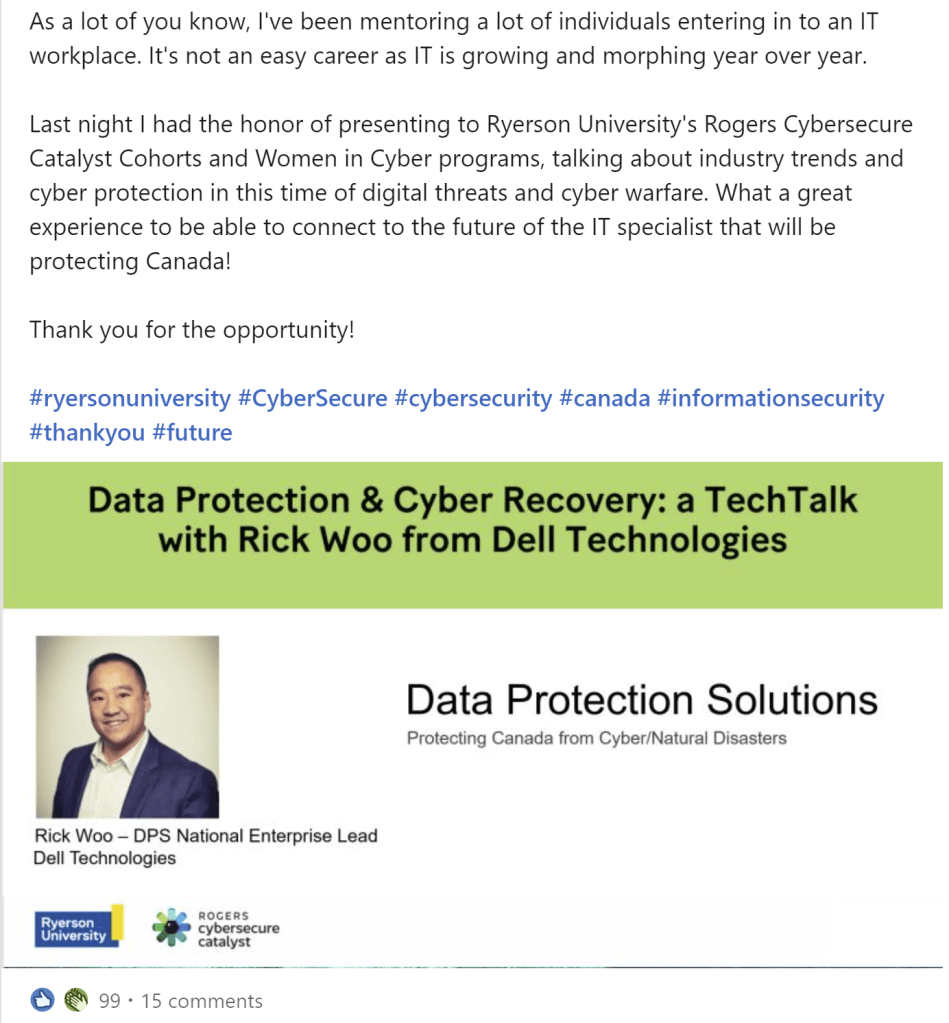
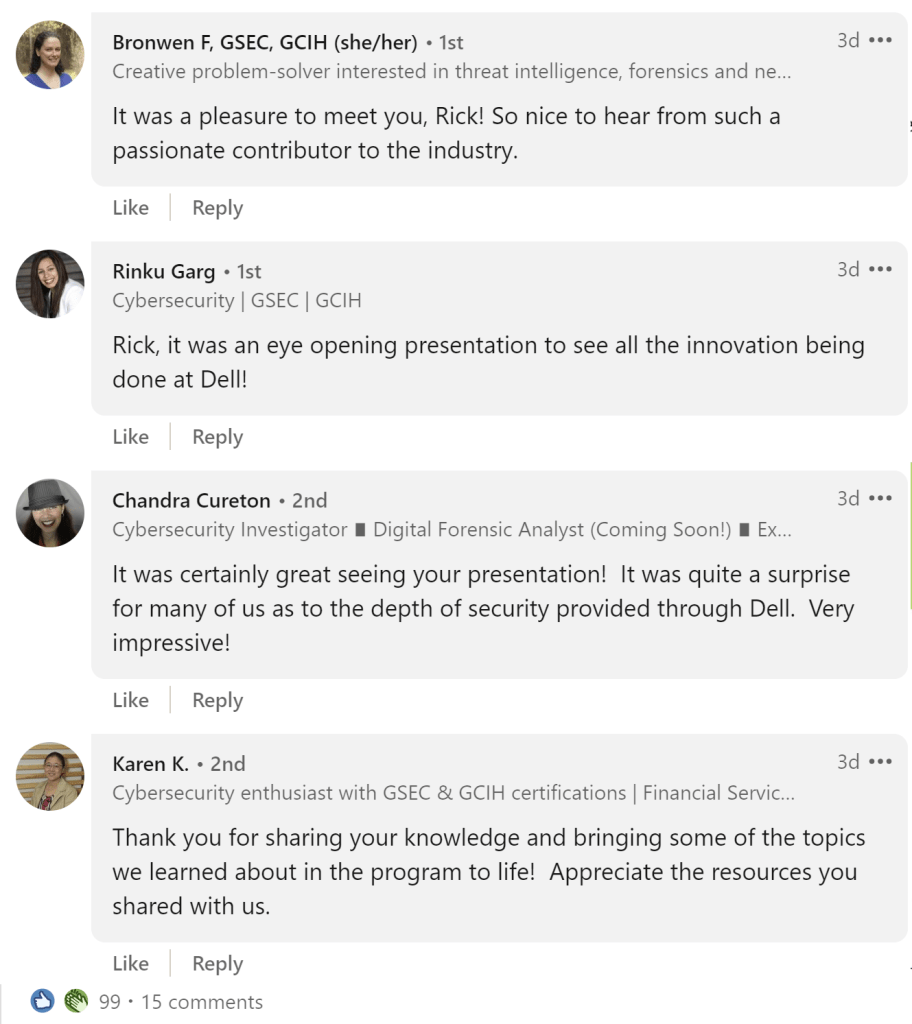
I had the pleasure to speak at Ryerson’s Accelerated Cybersecurity Training Program this week.

I got a lot of great questions and it was great to speak to those about to enter into the Cybersecurity space. I was asked about data protection in the a new IT landscape with multi-cloud and open to cyber threats daily. I also had the chance to talk about AI and how I see it evolve into supplementing a human to create more value. It was extremely interesting to see the questions from the session.

If you have not heard of this program and in Canada feel free to take a look at www.cybersecurecatalyst.ca . Not only do they train you, but they help you place a job in IT, by partnering with large organizations. Based on the questions and knowledge I’ve seen from the students, I truly believe this is a great program if you’re interested in getting into a Cyber Security field.

Look through your local universities, colleges, etc as they offer a lot of graduate IT sessions that help educate you, as well as work with local organizations to get you a job after. In fact, others schools in Ontario, such as Humber College also offer oversea programs if you are planning to move to Canada. Check out: https://newtocanada.humber.ca and click on Bridging Programs.

Hope our brothers and sister are staying safe in this difficult time,

Rick@ITJob.coach

Adding a picture to your Resume?

I’ve been asked before if you should add your picture in a resume? Well the answer for everything in IT is “It depends”. If you’re getting ready to join an IT career, this is the common answer. Why? Well, people in an IT career are very process focused. It’s never YES or NO, it’s always it depends based on the data.

Having good picture can help your chances of getting a job or reduce them. There’s studies that show back when there were minimal TV’s, presidential debates on a radio where people focused solely on voice had a whole different result when someone can see the faces on a tv.

So what factors do you have to consider about?

  • It depends on where you live and the culture around it?
  • Do you have a good picture that gives off a good impression of you?
  • Does the message from your picture reflect the position you’re applying for?

Environment:

Before you put your picture on your resume, is this normal? Is it taboo in your region? In these scenarios, it’s better to follow the standard. Look up people in the same field as you on LinkedIn – do they do it? Is there anyone you know in the field that can help give you insight?

Quality of the Picture?

Do you have a great picture that shows professionalism? Or is it in poor lighting, an awkward smile? I’ve heard of resume pictures that are similar to prison pictures or something you might find on a social media post. I’ve actually seen some pictures that are out of focus, or show someone’s backyard more than their face. Your picture should represent your brand and show you in a good light. If you don’t have any pictures like this, please do not include it.

If you have a good picture, but awkward background, use free tools like http://remove.bg to remove the background. It’s very straight forward to use. (See my resume picture to see how I’ve used it to remove the background in my other post). Ideally, if you can afford it, get a few done professionally. The 40$ will pay off exponentially when you get that job.

Does the Message of the picture align with the Job?

My favorite resume I got of someone applying for a senior position had a picture of him BBQ’ing in a T-Shirt. What message is your picture giving? Is it super colorful and full of excitement when you’re interviewing for a role that is asking for discrete and conservativeness? Are you showing a face without a smile for a role that requires a lot of positive public displays? Contradicting pictures on a resume can definitely hurt you more than you realize!

Some of you reading this might say – but this is obvious. The reason I actually have to write it out is that, apparently it isn’t. I’m still surprised at how some pictures are attached to resumes that could make someone lose a chance of an interview.

Think through what you’re saying with your picture, and if you have to ask – my 1 bit of advice is not to put it.

Good luck,

Rick@ITJob.Coach

My Resume???

So, I’ve talked to you guys about creating a resume so much. Some of you on my private rooms asked to see my resume!

I won’t be able to share 100% of my resume publicly as some of the information and tasks I’ve done are semi-private non disclosure. I’d also have to remove it based on where I interview to protect the companies that I work for. I keep those in there in case I apply to other areas in the organization. I always strongly suggest, you create your resume based on where you apply, so you shouldn’t have a resume that can be just openly published. But it’s a fair statement – and what I can show you is something that is fairly consistent in almost every job I would apply for.

WARNING – DO THIS BEFORE YOU LOOK

Before you look at my resume – try to do a 5-10 second glance and determine your opinion. I’ve explained a hire manager’s first impression. So understand the impression you get when you look at my resume.

Next, do a quick 30 second read of the resume and determine your impression of me. Remember, you’ve never met me or know me at this point – but after the 30 second read, what do you think of me as a person? Would you want me in your team? That is what my previous resume discussions are showing you about first impression.

Do the above 2 steps before you scroll down to look at my first page of my resume as it will be extremely valuable for your own learning, and what you put out in the future.

Here is the first page of my resume that is pretty standard and I’d edit it just a bit depending on where I’m applying:

For the others parts, it would be listing out my skills and then work experience as I’ve shown you in my previous videos.

Hope this helps you along in your IT career,

Rick@ITJob.Coach

Be a contractor? or Work for a company?

I got this question that I would like to address:

Hi Rick, I wanted your input on what do you think of me learning everything I can about AI/ML, Computer Science & Software Engineering & just launching up my own company with the skills I have? I feel like that could be better vs always seeking for a job. I’ve always had the attitude of going into work for myself type of person. 

Dante

There are 2 parts here that I believe my thoughts might help others:

  1. Being an expert in AI/ML and Learning Everything in Computer Science & Software Engineering
  2. Running a company rather than looking for work

Being an Expert

Let’s address the “expert in AI/ML” – first, AI/ML itself is a specialty with many flavors. I can tell you that even those in one of the flavors work very long days, study hard, doing research and even building to the AI/ML community feel that there’s so much more to learn. It’s continuously evolving. Then, so is Computer Science and Computer Engineering – as they are 2 types of studies. I myself would have trouble in being an expert in all 3 as it can be a full time job to learn just one well, and not be an expert. You’ll also need to have 3-5 years experience to begin to really understand it. Don’t think of this like learning a course in Udemy. Forget the notion that a 30 hour course will make you a master of something.

Think about a mechanic that gets out of school, and still has to apprentice for a long time to be a real mechanic. Yet he’s still considered a mechanic until he’s been doing that for a while. Only, after worked on cards for 5 years or more does he become someone who knows it very well. But another car coming in might surprise him and he has to look at the manual and try to fix that new car. That’s the same thing. However, a mechanic working just on Honda branded cars, and focus on brakes can become an expert.

Computer Science and Computer Engineering are 2 different wide fields. One has to do with knowing how computers and code work, and the other is to build things with computers/code. They are in itself wide fields, yet working for 20 years, I’ve never met someone who claims to be an expert in one vs the other, as it’s always evolving and always something that we don’t know.

Running a company vs Looking for work

When you work for yourself, you can start a company or be a contractor. However, most contractors I know continuously look for contract jobs (the looking for work that you’re avoiding). They do get larger salaries, because companies hire them for shorter periods say a few months or a year, and after that they have to find other contracts. The bigger salary is because companies don’t have to pay you benefits or vacation time/sick time. If you get sick, you don’t make money.

The other option is, starting your own company – and perhaps even hiring staff. The CEO’s I know that own large partnership or services delivery organizations have a vast network of contacts. They use these relationships to get large contracts to hire out their staff. They also have excellent brands and a vast pool of experience and history in executing on service delivery. If you are starting out, you would need to create a brand and have a proven track record. Companies are going to check your references – put you into a legal contract to deliver, and possibly even make you liable for non-delivery or damages. The owner typically works on sales campaign, profit analysis, hour utilization of his/her staff and extending his contacts to find more work for his resource pool of talent.

You can surely do this, but your chances would be better if you are well connected. I’ve known CEO’s that have very little charm, but they are so connected that they can reach out to their network to get some of the hard things done. Others are very visionary, and can inspire others to get all the hard work done as they lead.

1 Bit of Advice

Remember, IT is a vast field that is changing all the time. The laptop I got to write this post was outdated by the time it shipped to me. So is the development languages, the architected solutions, the products we use, etc. IT is evolving and a specialty that is in need today can change tomorrow. We have to maintain the eternal learning attitude to keep ourselves up to date. We have to study like our jobs will be outdated in 2 years. The person that created PERL (Guido van Rossum) doesn’t consider himself an expert on PERL, as he learns new things about it each day.

With that being said, nothing is impossible. I’d say if you practice AI/ML very well, keep in tune with it’s evolution, yes – you can be an expert. Also, with the shift of the workforce to remote and JIT (Just-In-Time) workforce (e.g how Fiverr works), it can definitely be the wave of the future. The industry is moving towards a consumption model of IT (cloud services) and elastic workforce in an OPEX model, and this can be exactly what you’re looking for.

Rick@ITJob.coach