

You got your IT cetification or passed your University courses and ready to get into the job market. You’ve googled resumes. There’s so many types out there. Some are visually awesome. Some are boring. You like a few, but now what? Do I copy it and just start adding in items? Does it apply to me? You might even have built one and submitted it a few times and got no one calling you back – Now What?
Biggest Problem about resumes?
The biggest problem as a hiring manager for a large IT organization, is I see hundreds of resumes everytime I put a job posting out. Some of the resumes have tons of skills, but not very relevant to the role I’m hiring for. It also gives me a good indicator of what happened.
I’ll use my favorite fictional IT character, Joe the IT guy in my example. Joe the IT Guy is looking for work. He goes on his favorite job search site and applies to 10-20 jobs. Fills out each application, submits his resume. Then goes off to browse his social media site waiting for a response. Does this sound like you?
The big problem of those coming off of other fields is their past experience. They got advice from a career counselor, or a brother or sister, or a friend about how to build a resume. They might just randomly google a resume and started marching forward.
IT Resumes – not 1 Size Fits All
That advice they’ve gotten – usually comes from people who applied for jobs that are very transient. Meaning, it’s not based on a specific skill set. Hiring managers might just be interested in your basic skills (organization, analytical, etc.) and can hire you into their organization. Joe the IT Guy is under a lot more constraints.
If I’m hiring an arhictect, and see resumes with 10 or 20 coding languages, and nothing else, it gets thrown out. If I hire for a cloud engineer, and all they talk about is IT program management, that also gets thrown out. So what do you do?
The steps to a Great IT Resume
Let’s start off with making sure you have a very good resume. This post is about the 101 – the basic introduction to building a resume. I will follow up with more steps and possibly a video to describe all of this for the visual learner.
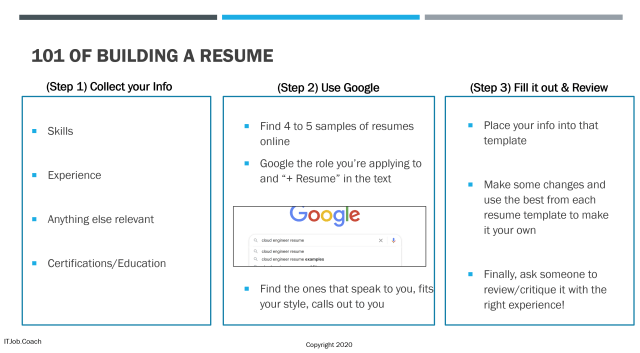
Let’s get started on the 3 basic steps of getting a good resume.
Step 1 – Collecting your info
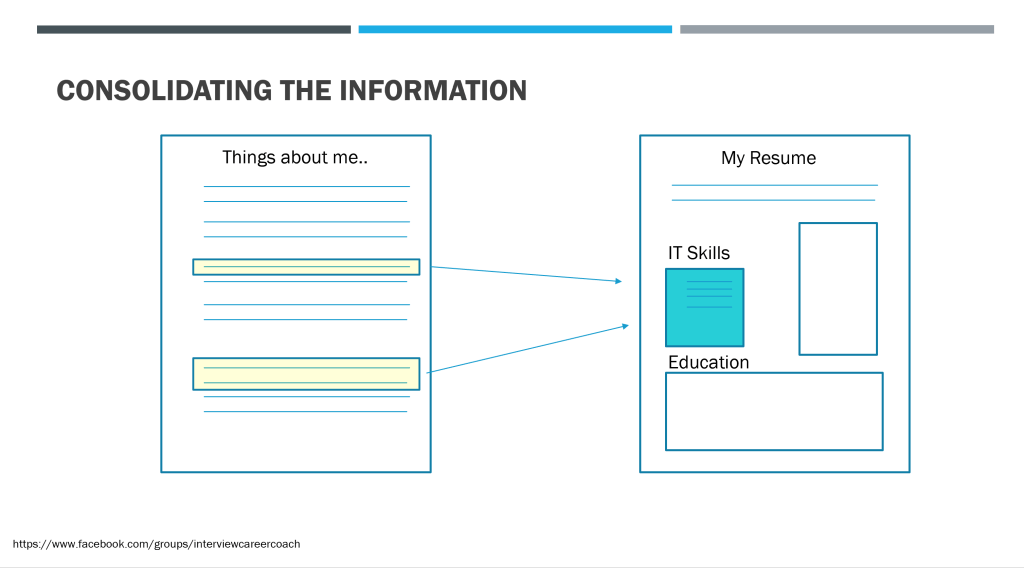
Collect all your information including your skills, any experience that shows you demonstrating your skills, your certifications, awards, education and put it on a single piece of paper. We’ll call this “Things about Me“.
In this step, more is better. Anything goes. Add Charity work, add information about how you helped your brother build a model plane in the garage and now he flies realy planes, etc.
Don’t worry about too much at this stage. All examples help. We won’t use all of it, but if we ever do need it, we will have it ready.
If you don’t have a lot of job experience, I will have a future blog on what to do.
Step 2 – Use Google
Now, start collecting sample resumes online. Use google and be specific about the job you’re looking for. Make sure you have a few that really call out to you. You’re feeling comfortable that it can create a good structure to represent what you’ve collected in step 1.
As a good google trick, and most of you know this, when you search for “Cloud Engineer” as an example, you can use the “+” symbol to ensure keywords are included. So I would search on “Cloud Engineer + Resume”.
Get a few that you really like and get ready for step 3.
Step 3 – Fill it out and Review
This final section is about taking the info you have in part 1 and filling it out on paper in your resume. Take the structures of the different resumes you got from the step 2, and choose what you like best and create a structure. Once you have a structure, begin filling out the details with what you have from step 1.
Also, once you have something you’re pretty proud of, it’s time to get someone to review it. Now do yourself a favor – think about the expertise of the person. If your friend Tom just got hired, is he a good source for a good resume? Did he get lucky? What works for one person might not work for another. There are tons of content creator’s (including myself) giving out advice, but what’s their background? Are they giving you advice from their 2 interviews they did in their lives? Take everything, including anything I give you, with your own filters. The smartest people I know take the nuggets of good from each any advice and piece it together for themsleves so it works.
My advice is to get someone with IT experience to review it. If you don’t have anyone working in IT, you can use public forums, or even go to my facebook page and ask anyone to critique it. Remember to remove your private contact info or anything confidential. If that doesn’t work, you should get someone with sales experience or business experience to review it also.
My facebook coaching group is:
1 Bit of Advice: Quality over Quantity
The biggest advice I will give anyone out there is don’t believe because you applied to 20 jobs, you’re doing great. It’s all about quality over quantity.
Spend about 15 minutes – 30 minutes on every job you apply to, to customize each resume – copy and paste your lines from the “Things about me” to fit the requirements of the job description.
A specific resume that speaks to the job will increase Joe the IT guy’s chances of getting into the interview. Good luck out there!
This will be the first of several posts about resume writing so stay tuned!
 ITJob.Coach
Leave a comment